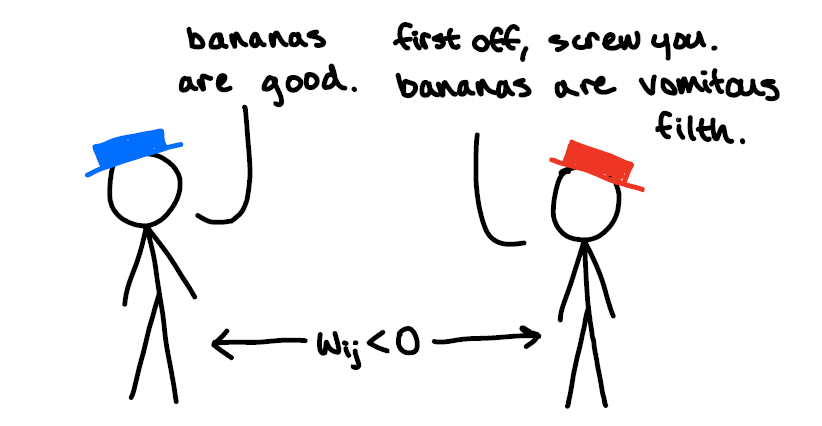
This project was inspired by my PTSD from Twitter wars. Traditional gossip models assume all influence is cooperative, but as any podcaster will tell you, influence on real social media is often antagonistic. I've always been fascinated by how online spaces produce signed relationships where trust, distrust, algorithmic amplification, and outside information all interact to produce collective dynamics, and this was a chance to look at that rigorously.
I am eternally grateful to my advisor, Ben Golub, for patiently entertaining my bouts of well-meaning but often misguided curiosity, for extracting usable meaning from my confused rambling with uncanny precision, and for dishing out pithy advice on everything from the future of robot mathematicians to the petri dishes of Twitter meme culture. Thanks also to the MMSS program for supporting the thesis.
It was interesting to work with a much more parsimonious model that is nonetheless as deep and rich as the ML theory I'd done before. I really like this flavor of very simple, very explainable, very write-down-able math, and I was continually surprised by how much depth there is to uncover, both mathematically and sociologically.
Abstract
Classical models of opinion dynamics assume agents update by averaging over their neighbors, treating all influence as cooperative — but both Bayesian learning agents and real social phenomena involve antagonistic relationships. A small recent literature introduces signed graphs with “opposing” and “repelling” update rules, but the existing analyses lean on restrictive assumptions: structural balance, absolute row-stochasticity, and constant external signals.
My thesis asks what happens outside that case. What is the long-run behavior under time-varying external information with repelling dynamics, and what breaks when structural balance is relaxed? I analyze linear opinion-updating rules on signed graphs with operator-theoretic tools (spectral radii, stability regions) to characterize regimes of convergence, damping, and instability, and to generalize key lemmas that relate structural balance to spectral properties.