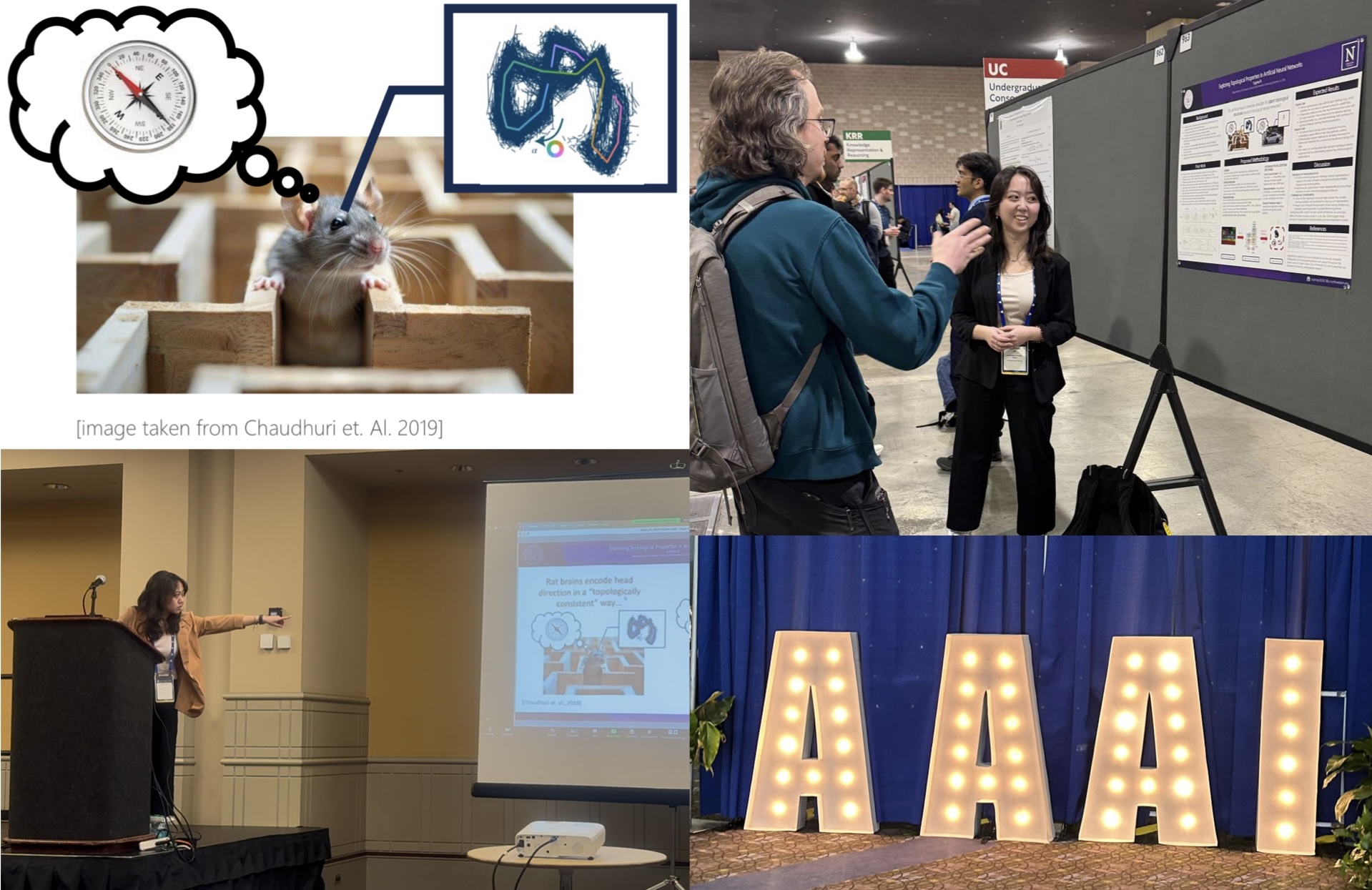
This project was the result of watching Ratatouille right after finishing the final for my cognitive psychology course. Many thanks to Prof. Adrian Rodriguez Contreras for fielding my incoherent questions about neuralinked rats and the psychology of autonomous cars, and to Prof. Peer Herholz for pointing me toward a pile of genuinely useful resources.
I'm also grateful to Jason Grant, the AAAI UC chair, for his mentorship, and to the other UC students for sharing their research and perspectives with me during the conference.
Presenting this poster was a great time, not least because of how much enthusiasm for topological data analysis came from the people who stopped by. I'm not actively working on this at the moment, but TDA is something I'm still very interested in and hope to use more of down the line.
Abstract
Biological neural systems often represent information on low-dimensional manifolds that reflect the topology of the variables they encode — rodent head direction cells forming circular manifolds being the canonical example. This proposal asks whether artificial neural networks trained on tasks with well-defined topologies develop similar low-dimensional representations: planar or spherical coordinates from autonomous driving datasets like Apolloscape, cyclic temporal variables, or graph-structured road networks.
The plan is to compare convolutional and vision transformer models on image data, graph neural networks on road network graphs, and 3D or point-based models on LIDAR point clouds, analyzing their internal activations with dimensionality reduction and topological data analysis. If it works, this would say something not only about the nature of internal representations in ANNs but about the computational principles bridging artificial systems and biological cognition.